Most A-Level students describe Stalin's Terror as a series of events — the Show Trials, the purge of the Red Army, the Great Terror of 1936–38 — listed roughly in order. That's a Grade C answer. A Grade A answer treats the Terror as a system with a function, and explains what that function was before it describes what happened.
Here's the paragraph that makes that shift.
"How far was Stalin's Terror a rational instrument of control?" — the model paragraph
"Terror functioned less as a response to genuine internal threats than as a mechanism for maintaining permanent insecurity among the population and the Party elite alike. By 1937, no official — however loyal — could feel secure, since denunciation could originate from any source and guilt was frequently assumed rather than demonstrated; the NKVD's arrest quotas, set centrally by region, meant local officials were required to produce a fixed number of 'enemies' regardless of actual evidence. This systemic, quota-driven character suggests the Terror's primary function was not the elimination of real opposition, which had already been largely crushed by the early 1930s, but the atomisation of society: preventing any independent power base, including within the Party and military, from ever coalescing again."
Notice the structure doing the work: it opens with a claim about function ("maintaining permanent insecurity"), not a narrative of events; it uses a specific mechanism (arrest quotas) as evidence rather than a general assertion; and it draws a historiographical distinction — real opposition vs. manufactured insecurity — which is exactly the kind of interpretive move that separates AO1 description from AO1 plus genuine analysis.
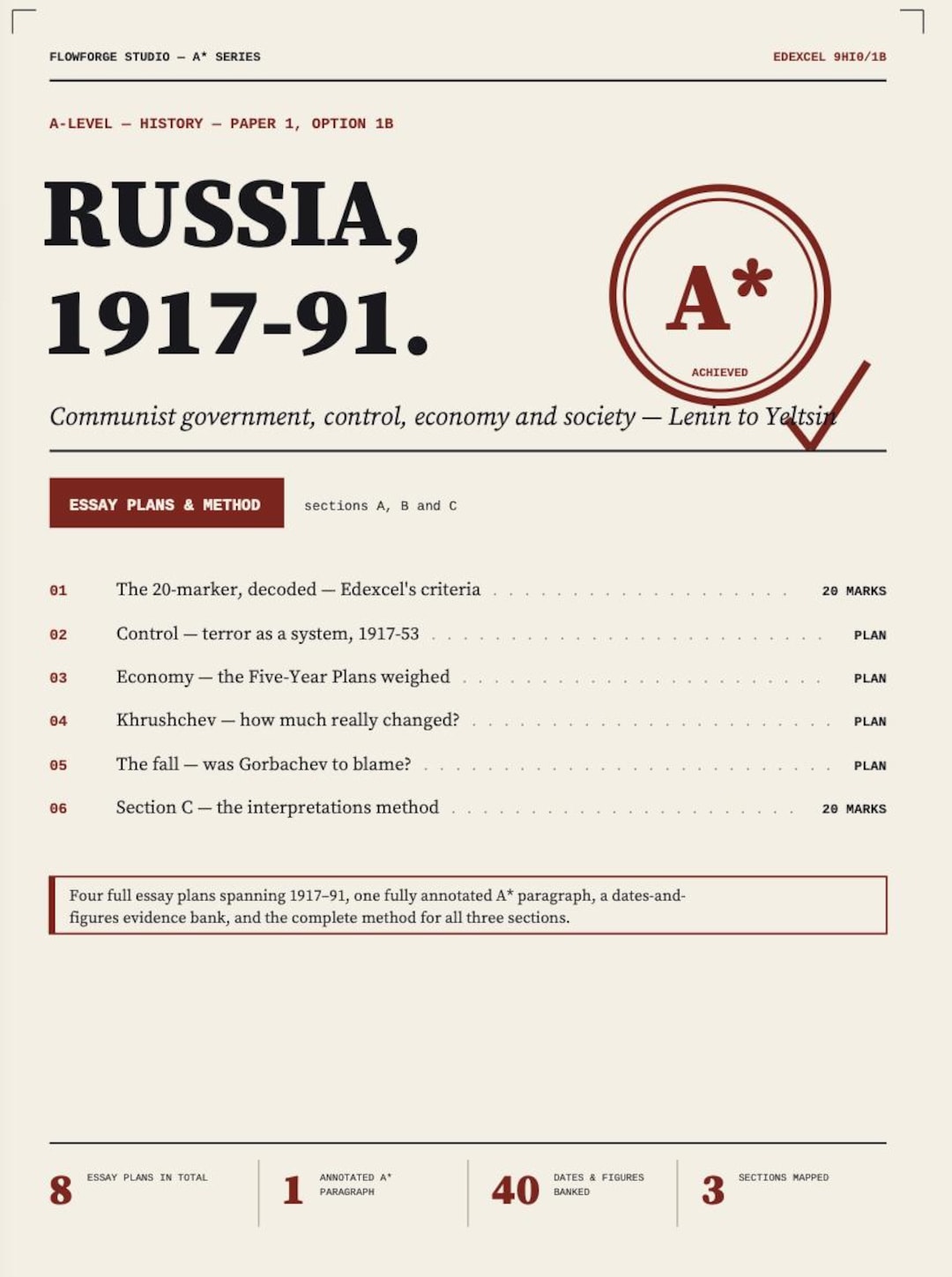
The A-Level History Russia Essay Plans — model paragraphs, 1917–1953.
The same "system, not sequence" method applies across the whole period — the Five-Year Plans reframed not as a story of targets met or missed but as an instrument for restructuring social relations under forced industrialisation, and Khrushchev's Secret Speech read not as a simple denunciation but as a calculated act of political self-preservation within the post-Stalin leadership struggle. Both get the same full model-paragraph treatment in the guide.
If the "function before narrative" method changed how you'd open your own next Terror paragraph, the rest of the guide is built to make that instinct automatic across the whole Russia specification.
See the full A-Level Russia Essay Plans
Want every major Russia essay question modelled this way?
View on Etsy