Almost every student studying The Great Gatsby can recite its final line. Far fewer can explain why Fitzgerald ends a novel about parties, wealth and a green light with an image of boats — or why that image lands as devastating rather than random.
Here's the sentence, and the mechanics behind it.
"So we beat on, boats against the current, borne back ceaselessly into the past."
What the extended metaphor is actually claiming: the image frames all human striving as a struggle against a force that will always win. Boats move forward through effort — "beat on" — but the current is stronger, and the outcome is inevitable: to be "borne back." Fitzgerald isn't just describing Gatsby's failure to win back Daisy. He's making a claim about the shape of ambition itself.
Why the pronoun "we" is doing so much work: Nick could have written "he beat on," keeping the sentence about Gatsby alone. Instead, the plural "we" universalises the failure — this stops being one man's personal tragedy and becomes the condition of everyone who chases a version of the American Dream. The anaphora of "beat on" and the adverb "ceaselessly" reinforce the futility with rhythm as well as meaning: the effort is constant, the result is fixed regardless.
It's worth reading this line alongside Gatsby's earlier insistence that "of course you can" repeat the past. Fitzgerald builds the entire novel toward the gap between those two positions — Gatsby's conviction that the past can be recreated through sheer will, and Nick's closing admission that no one, ever, actually beats the current. The green light, the parties, the shirts thrown across the room "like they were confetti" — all of it is the elaborate machinery Gatsby builds to deny a truth the novel's final sentence finally states outright.
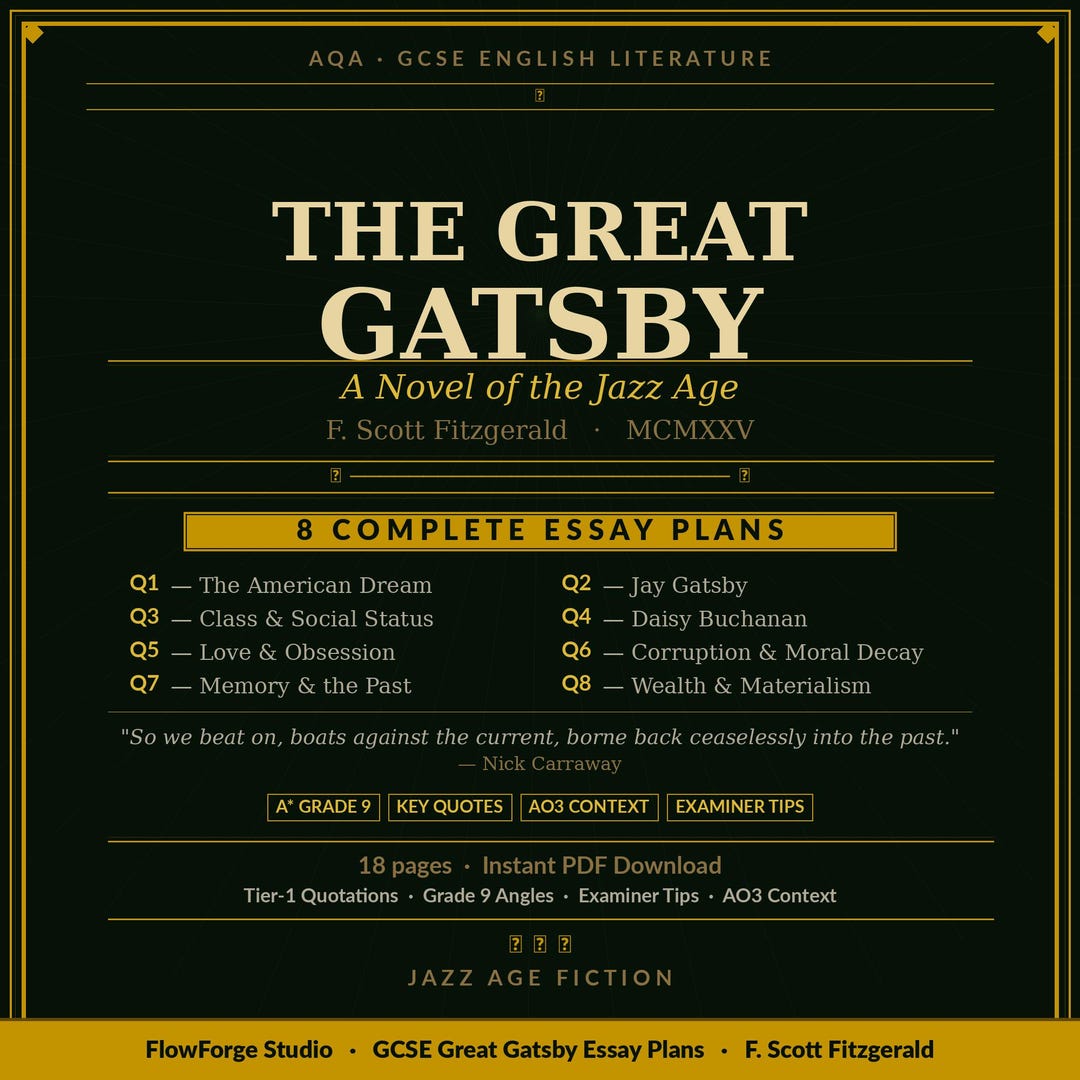
GCSE Great Gatsby Essay Plans — F. Scott Fitzgerald, 8 Grade 9 plans.
That's the novel's final line, unpacked properly. The full guide applies the same close-language method across every major Great Gatsby essay question — the American Dream, class, love, and illusion versus reality — each with tier-1 quotations and the Jazz Age context that turns a good AO2 point into a genuine AO3 one.
If "borne back" changed how you'd read that final sentence, the rest of the guide is built to make that instinct automatic.
See the full Great Gatsby Essay Plans
Want every theme built to Grade 9 standard?
View on Etsy