Every student studying Power and Conflict can quote "Look on my Works, ye Mighty, and despair!" Most explain it as simple irony — a boastful king, now forgotten. That's true, but it's the Grade 5 version. The Grade 9 version notices exactly where Shelley places the punctuation, and why.
Here's the full three-quote sequence AQA examiners want tracked across the poem.
"Look on my Works, ye Mighty, and despair!"
Why the exclamation mark is the whole joke: Shelley places it at the exact moment of maximum irony. The command demands an audience of "Mighty" rivals — but it falls across empty desert. Nobody is there to despair. Ozymandias's own words, carved by his own order, have survived only to mock him; Shelley weaponises the inscription against the man who commissioned it. The exclamation mark is the pivot: maximum confidence, delivered into a void.
The detail almost everyone skips — who's actually speaking: the words reach us through three narrators (a traveller, reporting what a sculptor carved, quoting what Ozymandias said). Each layer of retelling distances us further from the tyrant's original voice. Shelley's structural argument is that power is never received directly — it's always mediated, distorted, and secondhand by the time it reaches anyone else, which undercuts the very idea of a ruler's "direct" authority.
Then comes the line that finishes the argument: "Nothing beside remains." Three blunt monosyllables after all that grandiosity — deliberate anti-climax. And the grammar itself makes the point: "nothing" is placed first in the sentence, grammatically foregrounded, so that what's left of Ozymandias's empire is literally prioritised as nothing. Form and content collapse into each other. That's the move examiners are trained to reward — and it's the same structural trick worth hunting for across the anthology: pair Ozymandias with My Last Duchess or London for a comparison built on power's inevitable, self-defeating decay.
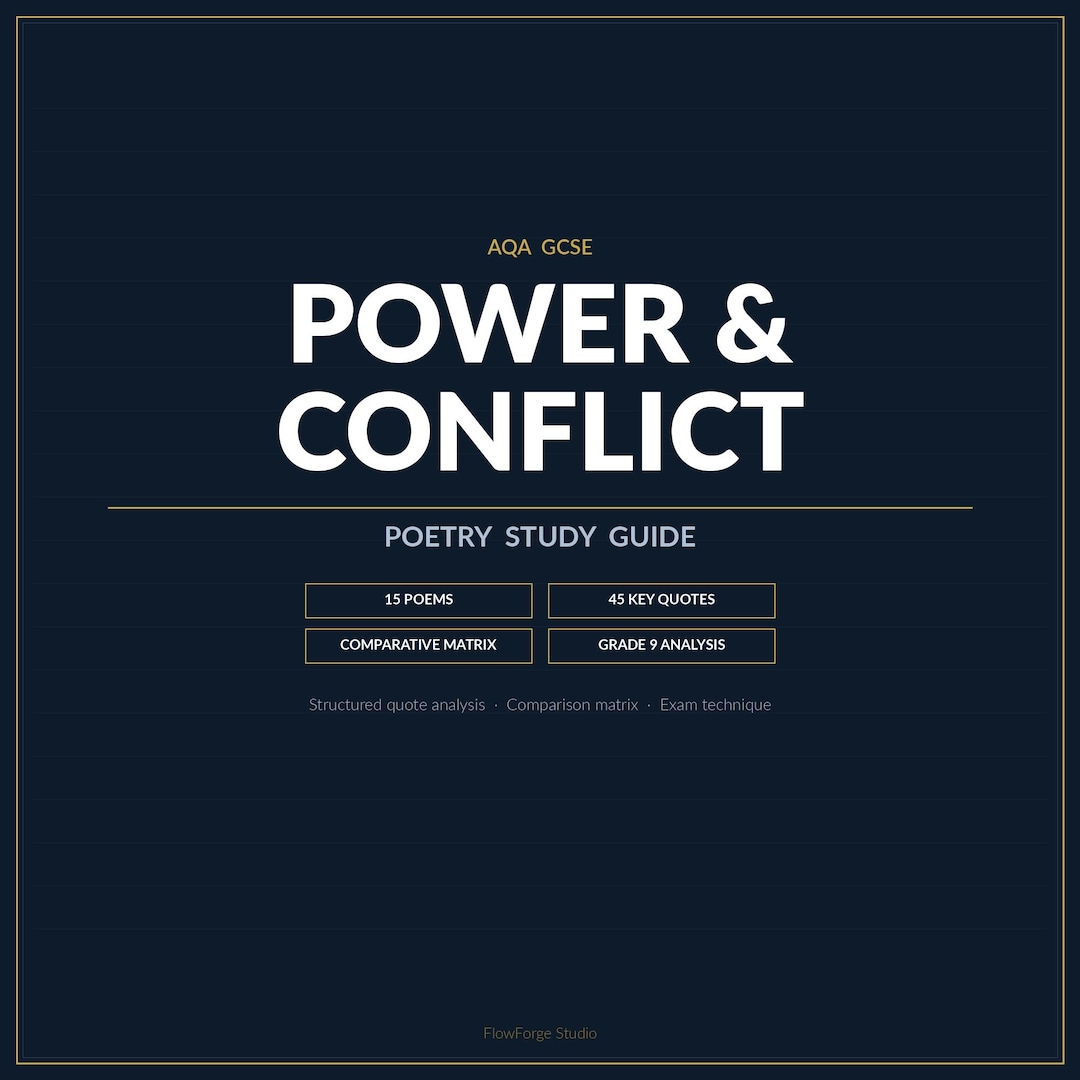
The AQA GCSE Power & Conflict Poetry Study Guide — 15 poems, 45 key quotes, comparative matrix.
That's one poem, worked at Grade 9 depth. The full guide covers all 15 poems in the anthology with three tier-1 quotations each, full AO2 language analysis, AO3 context, and a comparative matrix showing exactly which poems pair best for which themes — so you walk into the comparison question already knowing your strongest pairing.
If the exclamation mark changed how you'd read Ozymandias, the rest of the guide is built to make that instinct automatic across all 15 poems.
See the full Power & Conflict Poetry Study Guide
Want every poem built to Grade 9 standard?
View on Etsy