Most students quote Caliban's line about language as proof he's angry at Prospero. True, but "angry" barely scratches the surface of what Shakespeare has built into a single word choice — a choice that anticipates a whole strand of twentieth-century postcolonial theory by more than three hundred years.
Here's the line, and the word carrying the real weight.
"You taught me language, and my profit on't / Is I know how to curse."
Why "profit" is the cruellest word in the line: "profit" normally means gain — a return on investment. Shakespeare deploys it here with devastating irony, because Caliban's only "return" on being taught Prospero's language is the ability to articulate his own degradation. The commercial vocabulary exposes what colonial "education" actually is in this play: not a gift, but a transaction that leaves the colonised party in debt, having gained nothing except the words to describe his own loss.
What this means for how you read Caliban's cursing: he can name his captivity, but naming it doesn't free him from it — his cursing is simultaneously his one available act of resistance and the clearest proof of his limitation, since the only language he has to resist with is the coloniser's own. This is close to the argument Frantz Fanon would make three and a half centuries later in Black Skin, White Masks (1952): that adopting the coloniser's language alienates the colonised from their own original identity. Caliban is fluent in the language of the man who took his island, and voiceless in any other.
The line lands even harder once you register that Shakespeare gives his most lyrical, beautiful speech in the entire play not to Prospero, Miranda, or Ferdinand — but to Caliban, the character the "civilised" characters dismiss as "poisonous slave" and worse. That contradiction is the whole point: the "born devil" narrative Prospero tells about Caliban keeps colliding with a character whose command of language, when Shakespeare lets him use it freely, is more beautiful than anyone else's on the island.
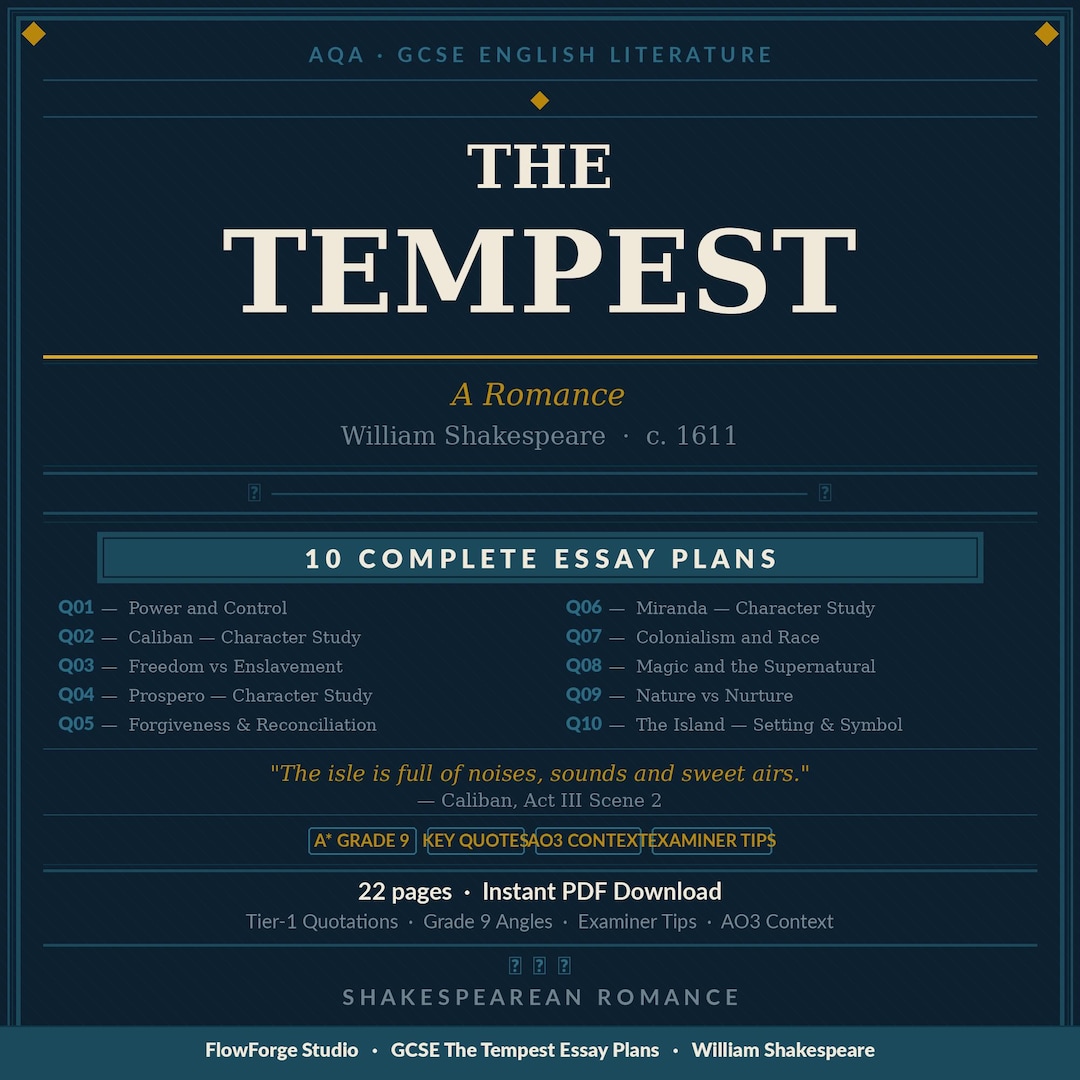
GCSE The Tempest Essay Plans — AQA, 10 Grade 9 essays, Shakespeare study guide.
That's one word, worked at the depth examiners actually reward. The full guide applies the same close-language method across every major Tempest essay question — power, colonialism, magic, and forgiveness — each with tier-1 quotations and the Jacobean colonial context that turns a good AO2 point into a genuine AO3 one.
If "profit" changed how you'd read Caliban's curse, the rest of the guide is built to make that instinct automatic.
See the full Tempest Essay Plans
Want every theme built to Grade 9 standard?
View on Etsy