Every Frankenstein essay eventually has to take a position on who the real monster is — Victor or the Creature — and most answers pick a side early and spend the rest of the essay defending it. That's a weaker essay than the one that shows the novel deliberately reverses the roles partway through, and uses one specific line of dialogue to do it.
Here's how that reversal works, worked in full around the line that carries it.
"You are my creator, but I am your master — obey!"
Spoken by the Creature to Victor on the glacier in Chapter 17, after Victor has refused to make him a companion, this is the single most examinable line in the novel for the creation-and-responsibility theme — and it's the line that most essays quote without actually unpacking why it's structured the way it is.
The technique: the line is built as a direct contradiction — "creator" and "master" assigned to the same sentence, the same breath, with the power relationship inverted between the two clauses. Grammatically, Victor is still named "creator": the word doesn't change. What changes is which word gets to control the sentence. That's the whole argument of the novel's second half compressed into eight words.
The AO1 point that gets marks: don't just say "the Creature turns against Victor." Say that Shelley uses this line to relocate power without erasing the creation relationship — Victor remains the Creature's origin, but origin stops being the same thing as authority. That distinction — between making something and controlling it — is the exact place where Victor's failure as a parent (rather than his ambition as a scientist) becomes the novel's real subject.
To see why the reversal lands as hard as it does, you have to go back to the moment the power relationship was still the other way round — the instant of the Creature's animation, four chapters earlier, when Victor still had every kind of power over him and chose to use none of it:
"I had gazed on him while unfinished; he was ugly then, but when those muscles and joints were rendered capable of motion, it became a thing such as even Dante could not have conceived... breathless horror and disgust filled my heart."
Read the two quotations together and the pattern is exact: Victor's first response to the Creature's existence is horror and flight — a refusal of the most basic act of parental recognition, at the exact moment recognition was needed most. The glacier confrontation is the Creature naming that refusal back to him, in the only language left available: not appeal, but command.
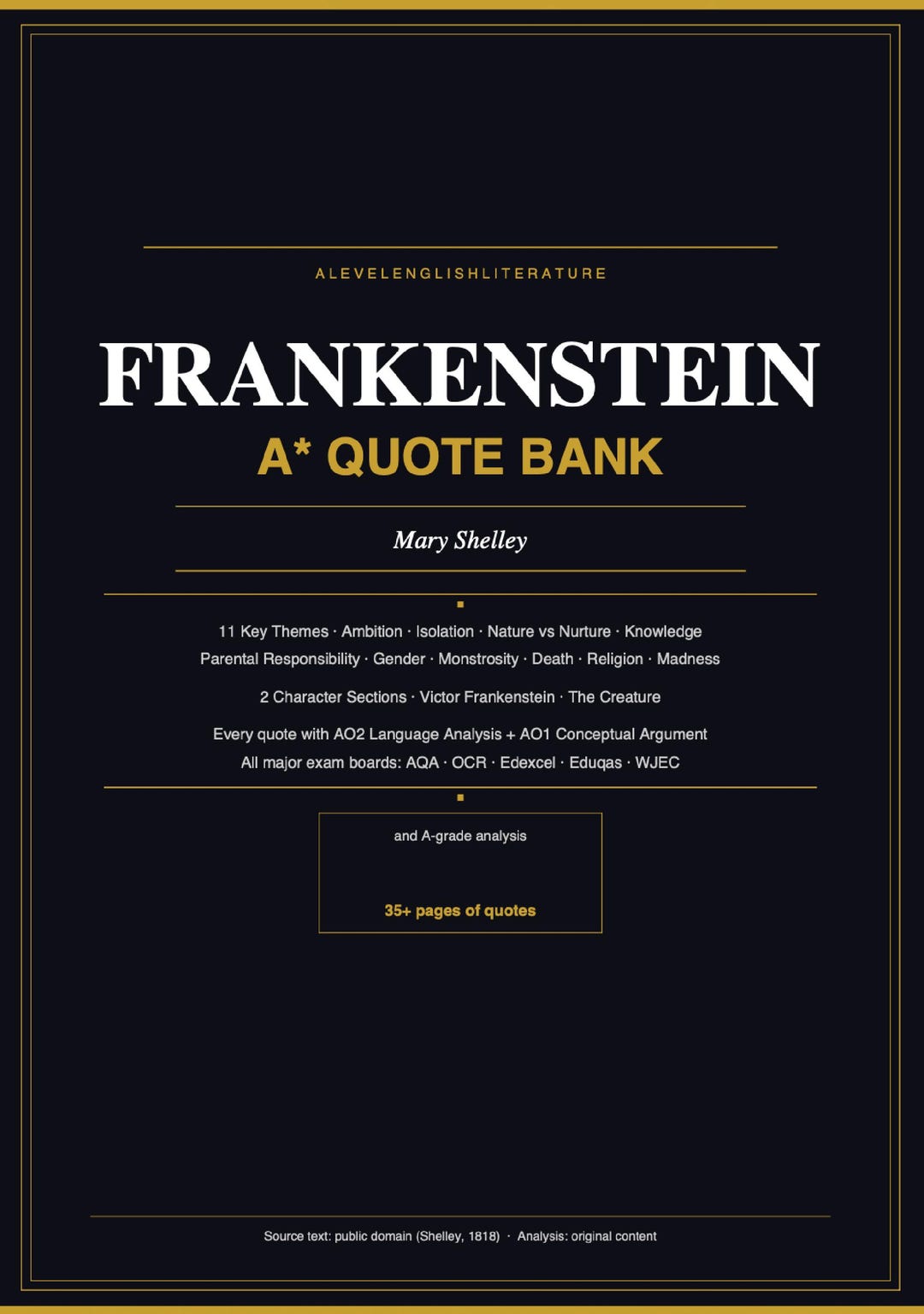
The Frankenstein A* Quote Bank — full AO2 analysis, every theme.
That's the full treatment for one quotation on one side of the theme. The Parental Responsibility section in the guide runs three more quotations exactly like this — including the idealised description of Victor's own childhood in Chapter 1, which gives you the contrast the examiner is actually looking for: the loving upbringing Victor received, set directly against the abandonment he inflicts.
What you won't find here, because it's the part worth paying for: the full AO3 context (the Paradise Lost epigraph and how Shelley uses Milton's Adam and Satan to frame both Victor and the Creature simultaneously), the De Lacey family cross-reference that most students never connect to the novel's parenting theme at all, and the other eleven themes covered with the same depth — Ambition & Overreaching, Isolation, Nature vs Nurture, Revenge, Knowledge & Its Dangers, The Sublime, Doubles & Doppelgängers, Gender & the Domestic, Narrative Framing, Science & Playing God, and Fate.
If today's page changed how you'd argue this theme, the rest of the guide is built exactly like it.
See the full Frankenstein A* Quote Bank
Want the complete guide with every theme and quote?
View on Etsy