Most A-Level students can list Streetcar's symbols on command — the naked light bulb, the streetcar itself, the bathing. Far fewer can explain why Tennessee Williams needed symbolism at all, which is the question examiners are actually testing when they ask you to analyse a symbol rather than just spot one.
The answer is in Blanche's own words, and it's the single most useful line in the play for unlocking every other image in it.
"I don't want realism. I want magic! [...] I don't tell truth, I tell what ought to be truth."
What this line does structurally: Blanche isn't just describing her own coping mechanism — she's stating the play's aesthetic manifesto out loud. Williams, writing in a period dominated by naturalistic theatre, uses Blanche's own defence of illusion as cover for his own departures from strict realism: the expressionistic lighting, the "Varsouviana" polka music only Blanche (and the audience) can hear, the paper lantern she places over the bare bulb. Every symbolic, non-naturalistic device in the play can be read as the theatrical form itself performing Blanche's philosophy.
Once you see that, the naked light bulb stops being "a symbol of harsh truth" in the abstract and becomes something more specific: Mitch tearing the paper lantern off it in Scene Nine is the literal, physical destruction of Blanche's stated worldview, staged as an act of violence against her — which is why that moment, not the rape scene, is what many critics identify as her true psychological breaking point.
The streetcar itself works the same way. Blanche's route to Elysian Fields — take a streetcar named Desire, transfer to one named Cemeteries, get off at Elysian Fields — isn't scenery. It's her entire biography compressed into a bus route: desire led her to ruin (the deaths at Belle Reve, the affair with a student), and she has arrived, finally, at a place named for the Greek underworld's paradise for the dead. Williams is using a literal setting detail as a structural prophecy of the play's ending, the same technique GCSE students meet in Priestley and Dickens, at A-Level sophistication.
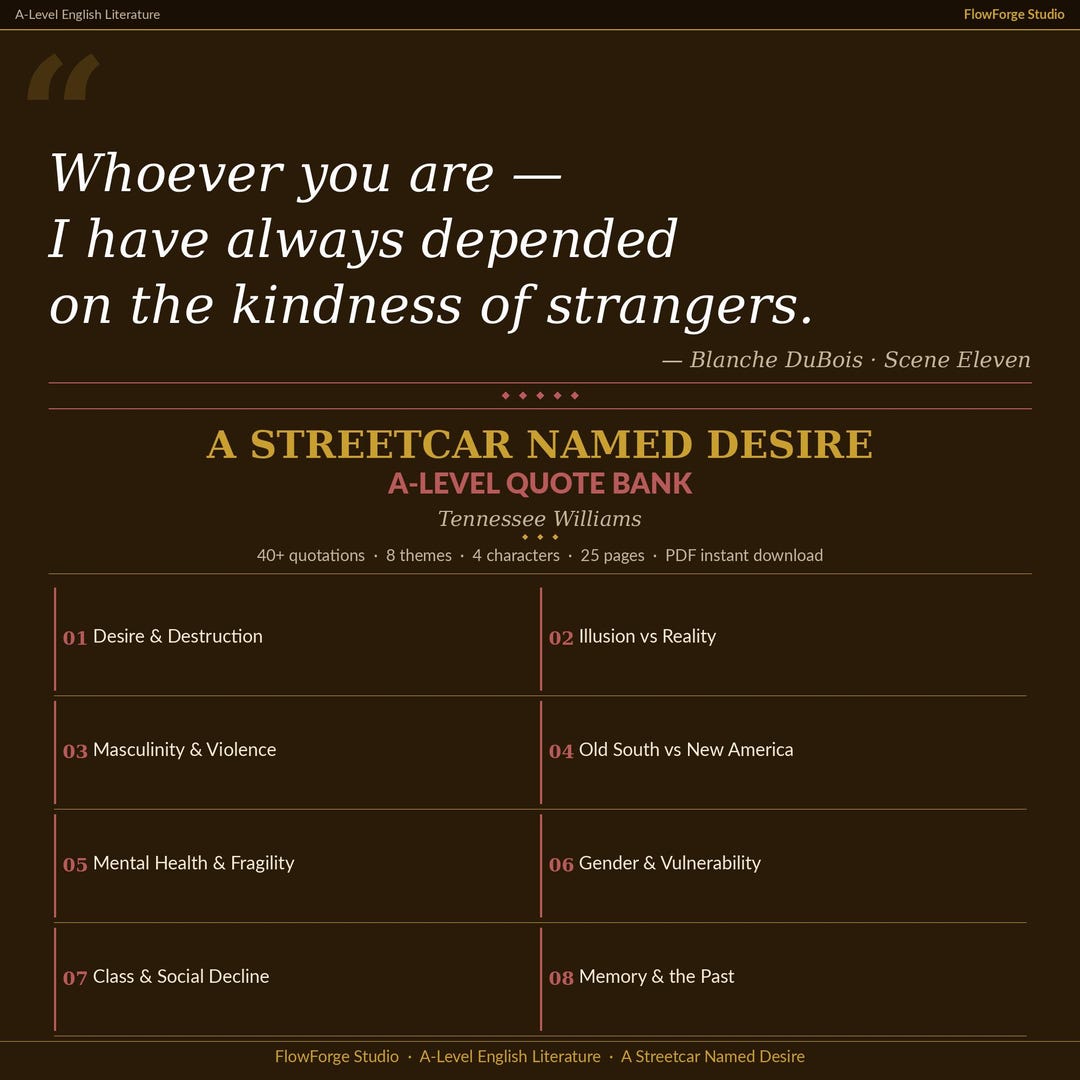
The A-Level Streetcar Named Desire Quote Bank — full AO2 symbolism analysis.
That's the method: read every symbol as an argument Williams is making about theatrical form itself, not decoration layered onto a realist story. The full quote bank applies this across every major symbol and set-piece in the play — the bathing motif, the poker night, Stanley's animal imagery, and the final "kindness of strangers" line — each with the same structural, form-and-content analysis.
If Blanche's manifesto line changed how you'd read the play's staging, the rest of the guide is built to make that instinct automatic.
See the full Streetcar Quote Bank
Want every symbol analysed to A* standard?
View on Etsy