Ask most GCSE students to open a Scrooge answer and they'll reach for "squeezing, wrenching, grasping, scraping" — the famous string of adjectives. Fewer notice what Dickens is doing at the level of grammar before Scrooge has spoken a single word: he's already built, sentence by sentence, a character defined by accumulation and refusal to stop.
Here's the method, applied properly.
"A squeezing, wrenching, grasping, scraping, clutching, covetous old sinner!"
What most answers say: "This list of adjectives shows Scrooge is greedy and unpleasant." True, but it stops at content — it treats the sentence as a list of synonyms rather than asking why Dickens chose to pile them up this way.
What a Grade 9 answer adds: the participle pile-up — six present participles stacked with no coordinating conjunction until the very end — mimics grammatically the compulsive, never-satisfied accumulation the words describe. The sentence itself can't stop, just as Scrooge's greed can't stop; form enacts content. Dickens is a serial novelist writing for a mass audience, and this kind of syntactic excess is a deliberately theatrical, almost performative technique — designed to be read aloud, which A Christmas Carol originally was, at Dickens's own public readings.
That's the reusable insight: whenever a GCSE text uses a list, a repeated structure, or a broken rhythm, the question worth asking isn't just "what do these words mean" but "what is this grammatical choice doing that a single adjective couldn't."
It pays off again at the transformation. By Stave 5, Scrooge's own language has changed shape: "I will live in the Past, the Present, and the Future!" — a triadic structure, balanced and complete, replacing the earlier chaotic pile-up. Dickens doesn't just tell us Scrooge has changed; the sentence structure surrounding him changes too, from compulsive accumulation to ordered resolution — and that formal echo is exactly the kind of AO2 point that separates a strong answer from an exceptional one.
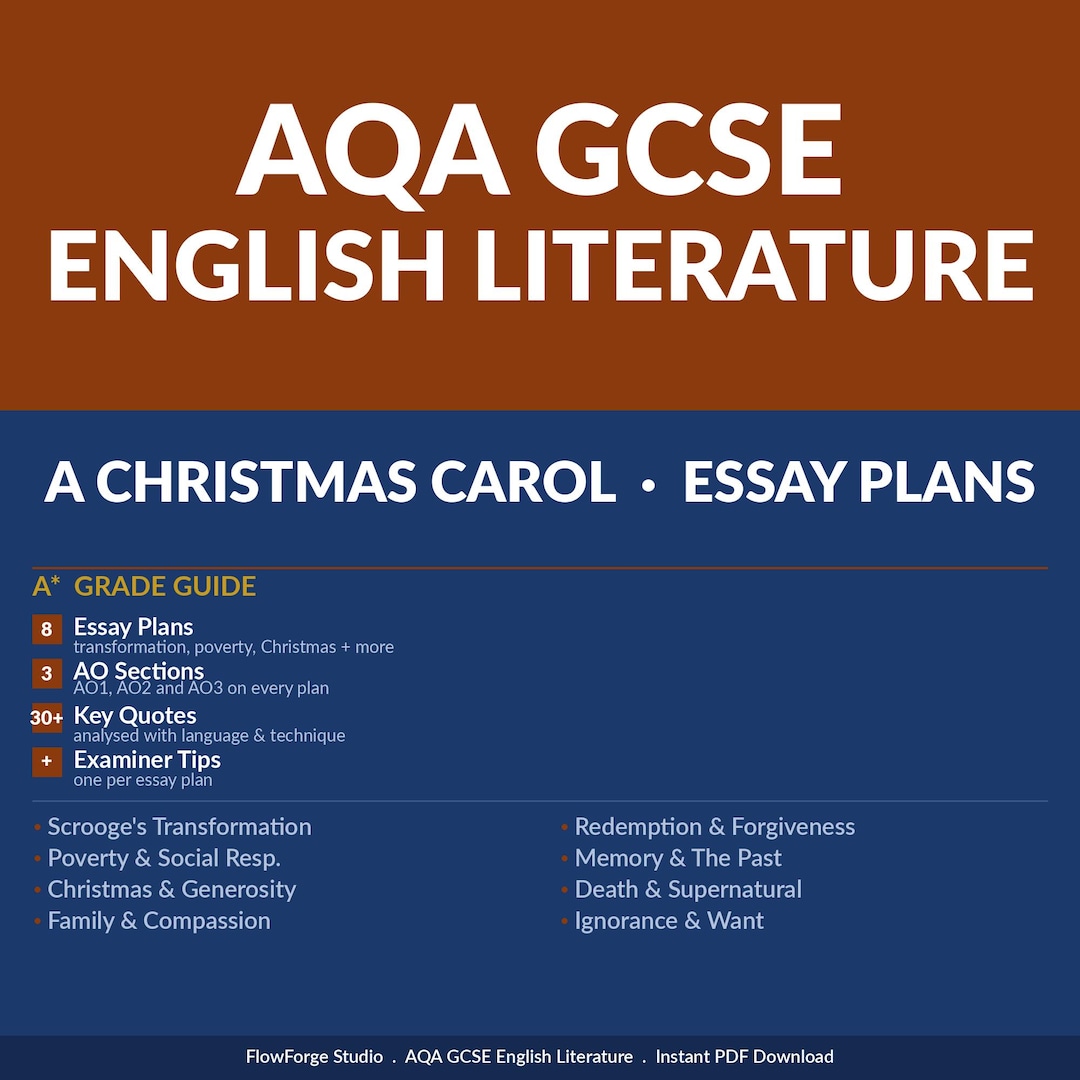
The AQA GCSE A Christmas Carol Essay Plans — 8 structured plans, AO1/AO2/AO3.
The same form-mirrors-content method applies to Ignorance and Want, the two children hidden beneath the Ghost of Christmas Present's robe — where their physical description ("wolfish," "prostrate") is structured to attack the reader's comfort directly before the Ghost turns Scrooge's own earlier words back on him. That scene, and seven more major essay questions, get the same full treatment in the guide.
If the participle pile-up changed how you'd read Dickens's syntax, the rest of the guide is built to make that instinct automatic.
See the full A Christmas Carol Essay Plans
Want every theme built to Grade 9 standard?
View on Etsy