Most students studying The Sign of Four quote "You have been in Afghanistan, I perceive" as an example of Holmes's cleverness and move straight to the next point. That's true, but it undersells the sentence — because Doyle isn't just showing off a deduction. He's choosing one specific word to define his detective for the rest of the genre.
Here's the line, and the word doing the real work.
"You have been in Afghanistan, I perceive."
Why "perceive" and not "think" or "guess": Doyle could have written "I think" or "I'd guess" — softer, more provisional verbs that leave room for doubt. He chooses "perceive" instead, a declarative statement of certainty. Holmes doesn't hedge. This single word establishes his defining feature: he doesn't reason toward probable conclusions, he sees what others miss as though it were simply obvious. The gap between what Holmes perceives instantly and what everyone else has to be told is the source of both his genius and his isolation.
What this does structurally for the rest of the novel: the moment also establishes Watson's role — perpetually amazed, perpetually one step behind, functioning as the reader's surrogate inside the story. Every time Holmes performs a deduction, Watson's admiring incomprehension gives Doyle a built-in mechanism for making Holmes's brilliance visible to an audience that can't otherwise access his thought process. Without Watson's confusion, Holmes's certainty wouldn't land nearly as hard.
It's worth pairing this with Holmes's other defining line — "Love is an emotional thing, and whatever is emotional is opposed to that true cold reason which I place above all things." Read together, the two quotations make the same argument from opposite directions: "I perceive" shows what Holmes's reason gains him, and the line on love shows what it costs him. Doyle is quietly asking whether genius and human connection can coexist — a question the novel never fully resolves.
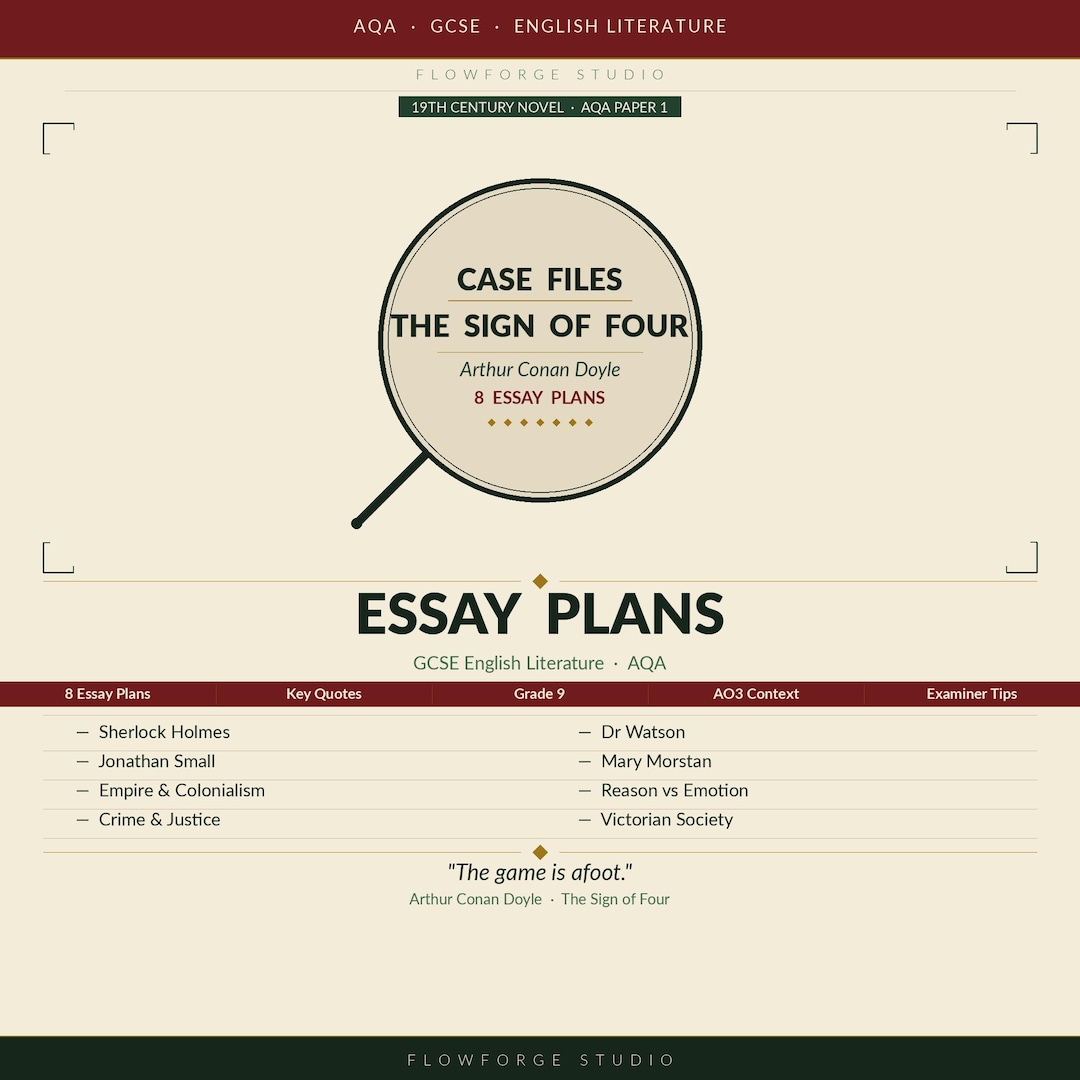
Sign of Four Essay Plans GCSE — Grade 9 revision guide, Arthur Conan Doyle.
That's one word, worked at the level examiners reward. The full guide applies the same close-language method across every major Sign of Four essay question — deduction, empire, class, and morality — each with tier-1 quotations for Holmes, Watson, Mary, and Jonathan Small, and the Victorian imperial context that turns a good AO2 point into a genuine AO3 one.
If "perceive" changed how you'd read Holmes's certainty, the rest of the guide is built to make that instinct automatic.
See the full Sign of Four Essay Plans
Want every theme built to Grade 9 standard?
View on Etsy