Ask most students whether housework is now shared equally between partners and they'll say yes — because that's the version of the story that circulates outside the subject. Ask a sociology examiner and the honest answer is "contested, and the contest itself is the mark scheme." This is one of the few AQA Family & Households questions where the "obvious" answer is actually the weaker one. Here's a full 20-mark plan done the way it needs to be done.
The question: Assess sociological explanations of the domestic division of labour
Thesis: the claim that conjugal roles have become symmetrical is only partially supported by the evidence — men's contribution to physical domestic tasks has increased, but the unequal distribution of emotional and mental labour within the household has been consistently underreported, which means "sharing" is real in one domain and largely absent in another.
Trend and evidence: Young and Willmott's "march of progress" thesis argued that the modern family was becoming increasingly symmetrical, with husbands taking on a greater share of housework and childcare as the traditional segregated conjugal roles broke down. This became the dominant public narrative — the idea that the domestic division of labour was a solved problem, trending steadily toward equality.
Why the trend (or why not) — theory: Ann Oakley's 1974 study directly challenged this, finding that despite some increase in men's participation, women still carried the overwhelming majority of domestic responsibility, and that "help" from husbands was often limited to specific, chosen tasks rather than an equal division of the full workload. The word "help" is itself doing analytical work here — it implies the task remains fundamentally the woman's responsibility, with the man assisting rather than sharing.
Duncombe and Marsden's 1995 concept of the "triple shift" extends this further: women in dual-earner households are shown to be managing paid work, domestic work, and a third, less visible category — the emotion work of monitoring, sustaining, and repairing the emotional health of the relationship and the family. Because emotion work doesn't appear on a time-use survey the way vacuuming does, studies measuring "hours of housework" systematically undercount the actual imbalance, which is exactly why the march of progress thesis could look statistically plausible while missing the deeper pattern.
Evaluation: Gershuny's time-use research is the strongest evidence in the symmetry thesis's favour — it does show a genuine long-term increase in men's contribution to domestic tasks across successive UK time-use surveys, and that trend shouldn't be dismissed. But Gershuny's own data still shows women retaining primary responsibility for the tasks with the least flexibility — cooking, cleaning, childcare on a fixed schedule — while men's increased contribution concentrates in more flexible, more visible tasks. The direction of change is real; the destination of full symmetry is not yet supported by the evidence.
Conclusion: the domestic division of labour has moved toward greater equality in observable, task-based housework, but the triple shift argument shows that "equal sharing" claims collapse once emotion work is counted — which means the most accurate answer to the question isn't "symmetrical" or "unequal" as a flat verdict, but a claim about which forms of labour have been redistributed and which have been left invisible by the way researchers chose to measure them in the first place.
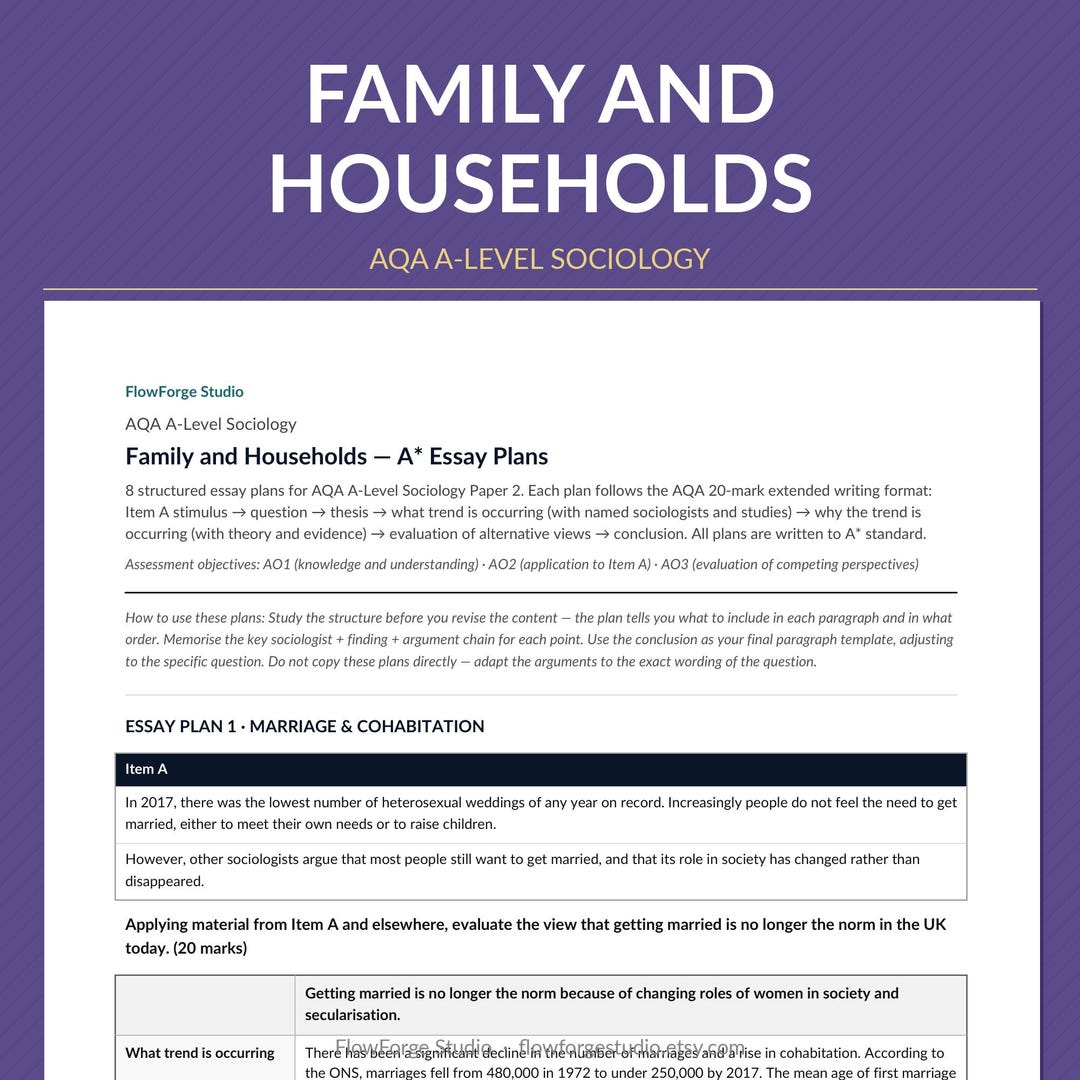
The Family & Households Essay Plans — 8 full 20-mark plans.
That's the whole method: a thesis specific enough to be arguable, real named studies doing real evidential work rather than decoration, and an evaluation that weighs the evidence instead of just listing a counter-study. It's the same structure examiners are trained to reward, applied to a question students consistently misjudge because the "commonsense" answer feels too obviously true to question.
The full guide covers all eight major Family & Households essay questions built exactly this way — Marriage & Cohabitation, Nuclear Family Decline, Feminist Perspectives on Gender Inequality, the New Right Perspective, the Social Construction of Childhood, Demographic Change, and Domestic Violence — each with the same Item A → thesis → evidence → theory → evaluation → conclusion structure, plus an examiner tip on every plan.
See the full Family & Households Essay Plans
Want all 8 essay plans, examiner tips included?
View on Etsy