Ask most GCSE History students to "explain two consequences" of an event and they'll retell the event in more detail instead. It's the single most common way marks get lost on this question type — not because students don't know the history, but because they never test whether what they've written actually happened after the event, caused by it.
Here's the method, worked in full on a real Edexcel question.
The test: does it begin after the event ends?
A consequence is a change caused by the event — not what happened during it. "The Airlift lasted 318 days" is the event. "The West decided a military alliance was necessary" is a consequence. Every sentence you write for this question type should be able to pass that test: does it begin after the event ends, and can you name the mechanism connecting them?
The shape that scores full marks: one change, one mechanism, one detail. Name the change, explain why the event caused it, prove it with a date or number. Four sentences per consequence is the top-band shape — not because examiners are counting sentences, but because that's roughly how long it takes to do all three jobs properly.
Here's what that looks like on the real question: explain two consequences of the Berlin Blockade, 1948–49 (8 marks).
"One consequence was the formal division of Germany into two states. Because the blockade proved the wartime allies could no longer administer Germany jointly, the Western zones merged into the Federal Republic (May 1949), and the Soviet zone answered with the GDR (October 1949) — the 'German question' frozen into two countries for forty years. A second consequence was the creation of NATO in April 1949. The blockade convinced Western governments that containment required a permanent military alliance, not just economic aid."
Notice what each consequence does: it names a specific, dated change (two German states; NATO's founding), and it explains the causal mechanism in one clause ("because the blockade proved..."), rather than just asserting that the change happened. That's the difference between a Level 2 and Level 3 answer on an 8-mark consequences question — and it's a difference of method, not knowledge.
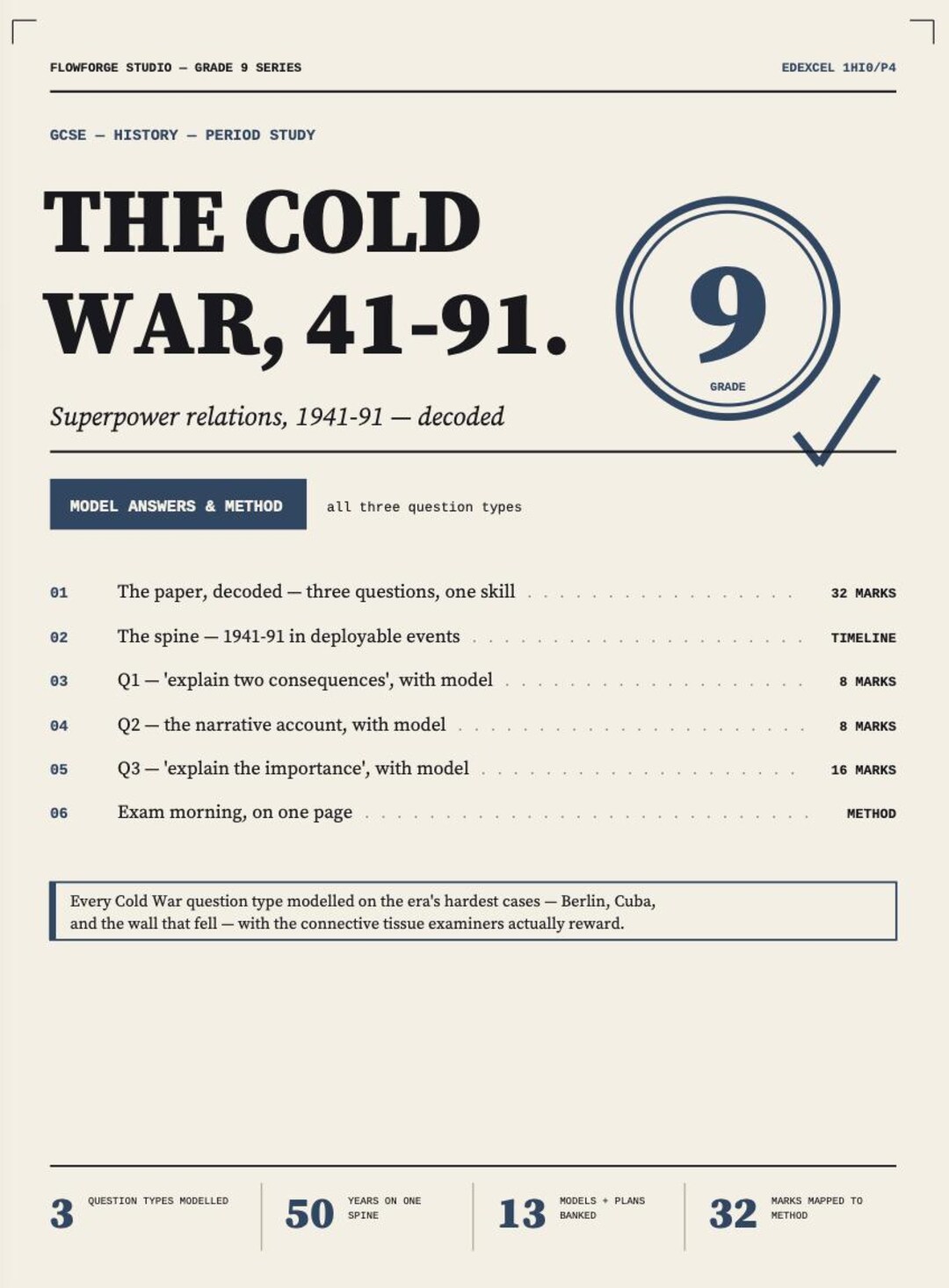
The GCSE History Cold War Grade 9 Pack — Edexcel Superpower Relations 1941-91.
It's worth remembering, while you're drilling the method, that the events themselves were not abstractions to the people living through them — Kennedy's own relief when the Berlin Wall went up in August 1961 was blunt: "a wall is a hell of a lot better than a war." The consequences you're asked to explain were real political choices made under real pressure, which is exactly why the examiner wants a causal mechanism and not just a fact.
The full guide covers this method across every major Edexcel Superpower Relations question type — the narrative account, the "how far do you agree" essays, and the source-based questions — each with a marked top-band model answer built from the real spine of events, 1941 to 1991.
See the full GCSE Cold War Grade 9 Pack
Want every question type covered, fully marked?
View on Etsy