Ask most A-Level Economics students what a rise in interest rates does and you'll get one true sentence: "borrowing becomes more expensive, which reduces spending." It's not wrong. It's also worth roughly a quarter of the marks a 25-marker is actually offering, because AQA doesn't reward the correct answer — it rewards how many correct links you can chain together before you stop.
Here's the same economic point, written at four levels, so you can see exactly where your own answers currently stop.
The four-link rule
Level 1: "Higher interest rates mean borrowing becomes more expensive, which will reduce spending." This is a GCSE-standard answer — true, but a single link, no mechanism named.
Level 2: "Higher interest rates increase the cost of borrowing for consumers and firms, reducing consumption and investment — components of aggregate demand — so AD shifts leftward and real GDP may fall." Now the link names the theoretical mechanism (AD components) rather than just asserting the outcome.
Level 3: "A rise in the base rate raises mortgage repayments and loan servicing costs for indebted households, reducing disposable income and depressing consumer expenditure; simultaneously, the higher opportunity cost of retained earnings deters capital investment, contracting both C and I — the two largest components of AD — shifting the AD curve inward and reducing equilibrium real output." This is where most strong students plateau: two separate transmission channels, both correctly named, both connected to the diagram.
The gap between a Level 3 and a genuinely top-band answer isn't more economics — it's one more question asked of your own reasoning: what does the size of this effect actually depend on? A Level 4 answer adds that condition explicitly: the transmission mechanism depends on the proportion of variable-rate debt in the economy, so in a highly leveraged economy like the UK's, a 25bp rise can meaningfully contract consumption — but how much depends on the marginal propensity to consume out of that lost income, and the final effect on real output is bounded by the slope of the AS curve.
That final move — stating the condition the whole chain depends on — is what AQA's mark schemes are actually looking for when they reward "sustained chains of reasoning." It's not extra facts. It's one extra "and this depends on..." clause, applied to the argument you'd already written.
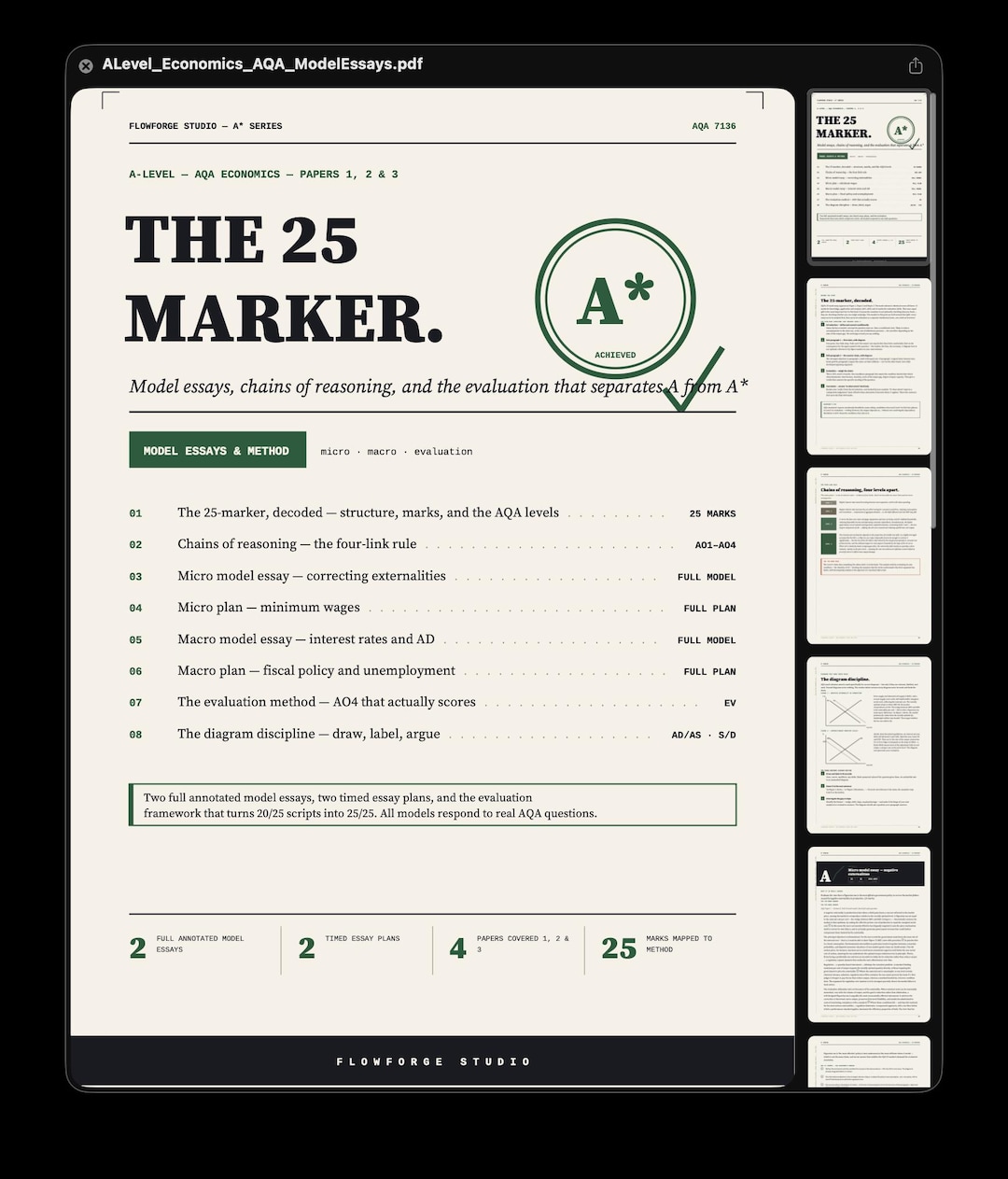
The AQA Economics A* Revision Guide — 25-marker model essays, micro and macro.
What you won't find here, because it's the part worth paying for: the diagram discipline that tells you exactly how to draw and reference Figure 1 (negative externalities) and Figure 2 (contractionary monetary policy) so they earn the mark AQA specifically allocates for diagram use — most students draw a correct diagram and then never reference it in prose, which forfeits that mark entirely — plus the full 25-mark model answer on Pigouvian taxation this four-link method is drawn from, and the equivalent chain-of-reasoning treatment applied across every major AQA Paper 1 and Paper 2 essay type.
If seeing your own answer stop at Level 2 or 3 was useful today, the rest of the guide is built to push every essay past it.
See the full AQA Economics 25-Marker Guide
Want every 25-marker built to Level 4, diagrams included?
View on Etsy