Ainsworth's Strange Situation is probably the single most-recognised study on the AQA Psychology spec — most students can name the three attachment types before they've even opened a textbook. The problem is that "can name them" and "can describe and evaluate the procedure to 16-mark standard" are very different skills, and the gap between them is almost always the same: students remember the types but not the method that produced them.
Here's the full AO1, worked properly.
Describe and evaluate Ainsworth's Strange Situation (16 marks)
AO1 — the procedure: Ainsworth and Bell (1970) — a sample of 100 middle-class American mother-infant pairs, using a lab-based controlled observation of infants aged 12–18 months. Eight standardised episodes, each around three minutes long, systematically assessed: exploration with the caregiver present, response to a stranger, protest at separation, and behaviour on reunion.
Three attachment types were identified from this procedure:
Type B — Secure (66%): uses the caregiver as a safe base for exploration; shows distress on separation; is easily comforted on reunion; is not wary of the stranger when the caregiver is present.
Type A — Insecure-Avoidant (22%): shows little separation protest; avoids the caregiver on reunion; is comfortable engaging with the stranger. This pattern is linked to emotionally unavailable caregiving.
Type C — Insecure-Resistant/Ambivalent (12%): shows high distress on separation and — the detail students most often drop — resists comfort on reunion rather than accepting it, seeking and rejecting contact with the caregiver simultaneously.
The reason examiners keep returning to this study isn't just the neat percentages. It's that the procedure operationalises something genuinely hard to measure — the quality of a relationship — into eight discrete, observable episodes, which is exactly the kind of methodological move A-Level Psychology rewards you for being able to describe precisely, not just gesture at.
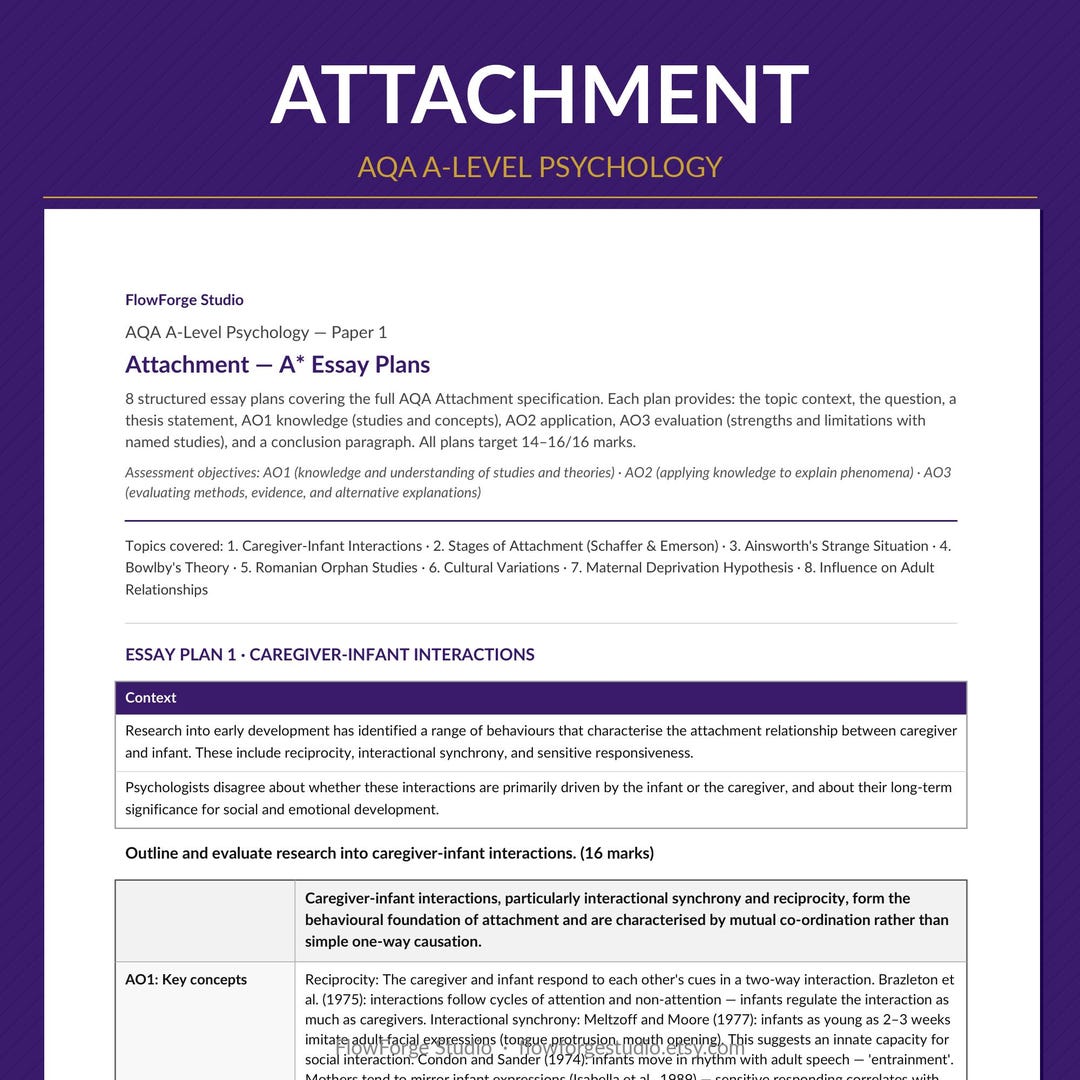
The AQA Psychology Attachment Essay Plans — all 8 major 16-markers, A* method.
That's a full, exam-ready AO1 — the kind of detail examiners are specifically checking for, not just "there were three attachment types." The AO3 evaluation is where this essay actually gets its marks though: whether the procedure is ethically acceptable given the distress it deliberately induces, and whether attachment types identified in a middle-class American sample generalise across cultures — both are genuine, examinable critiques, not throwaway lines.
The full guide covers all eight major Attachment essay questions built exactly this way — caregiver-infant interactions, Schaffer and Emerson's stages, Bowlby's evolutionary theory and internal working model, cultural variations in attachment, and the effects of institutionalisation — each with a full AO1/AO3 structure and an examiner tip on what separates a 12 from a 16.
See the full Attachment Essay Plans
Want all 8 essay plans, examiner tips included?
View on Etsy