Never Let Me Go is a novel students often describe as "sad" without being able to say precisely how Ishiguro engineers that sadness. The mechanism is hiding in one line from a minor character, said once, and quietly explaining everything about how the book actually works.
Here's the sentence — and why it describes the reader as much as it describes Kathy.
"The problem, as I see it, is that you've been told and not told."
What "told and not told" actually means: Miss Lucy's diagnosis applies to Kathy and the Hailsham students collectively — they "know," in the abstract, that they exist to donate their organs, but they don't know it in any way that changes how they live. Ishiguro uses the phrase to describe both the novel's fictional education system and, more unsettlingly, his own narrative strategy. The reader is told and not told too — most of us understand what's happening to these characters well before Kathy fully articulates it herself.
Why that structural choice is the point: Kathy's narration is famously measured, almost clinical, even when describing events that should be devastating. That gap between what's happening and how calmly Kathy tells it isn't a flaw in the prose — it's Ishiguro dramatising "told and not told" at the level of narrative voice itself. Kathy has spent her whole life absorbing information in forms designed to prevent it from being fully felt or acted on, and her narration carries that conditioning even as an adult.
This is also what makes Kathy more than a simple victim. As a carer, she spends eleven years preparing other clones for their donations, narrating that fact with the same acceptance she brings to everything else. Ishiguro never dramatises her complicity as a moral crisis — she doesn't rebel or refuse — and that absence of resistance is more disturbing than open cruelty would be, because it shows exactly how a lifetime of managed partial-knowledge produces compliance without anyone ever having to force it.
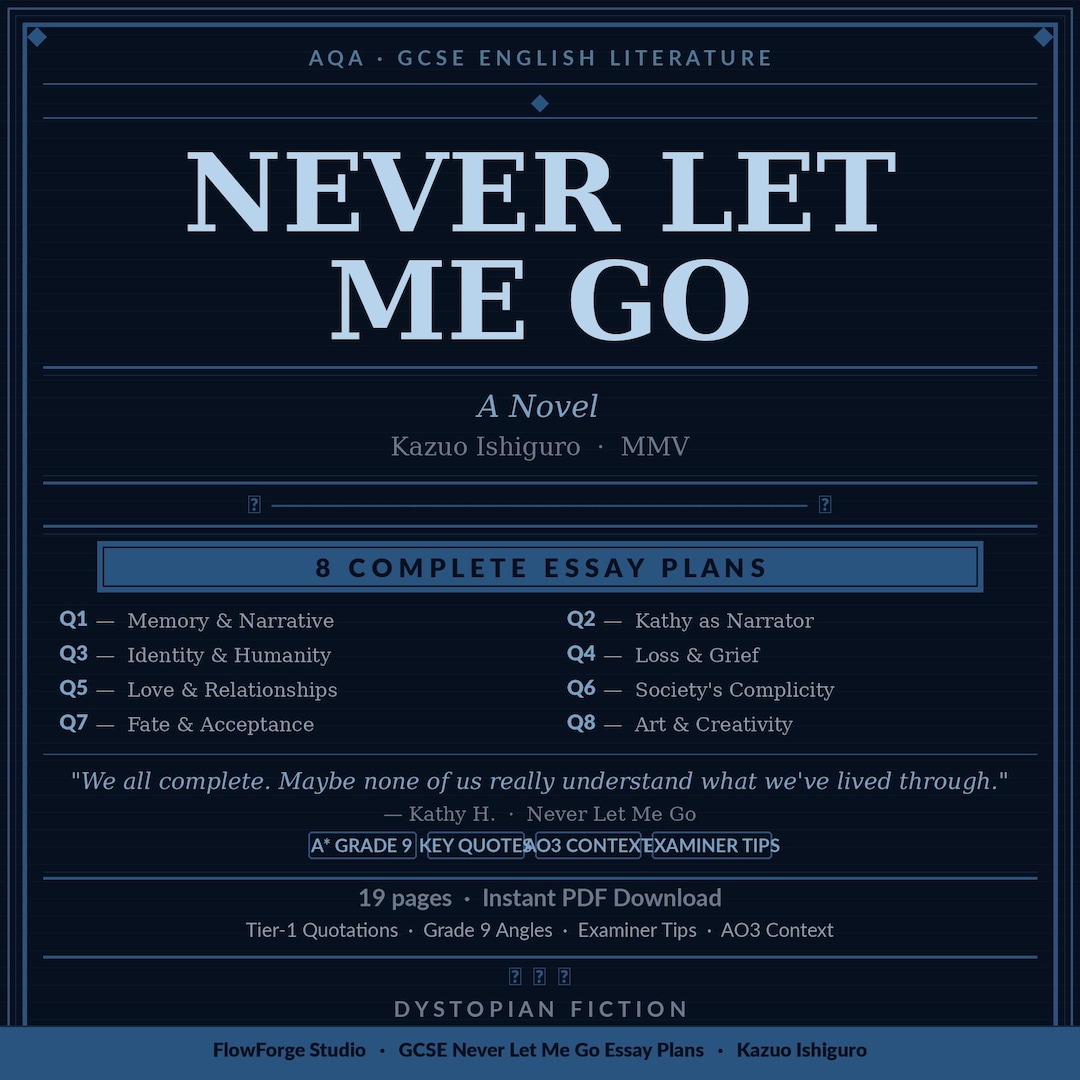
GCSE Never Let Me Go Essay Plans — Kazuo Ishiguro, 8 Grade 9 plans.
That's one line from one minor character, worked at the depth examiners reward. The full guide applies the same close-reading method across every major Never Let Me Go essay question — identity, complicity, humanity, and love under constraint — each with tier-1 quotations and the bioethics context that turns a good AO2 point into a genuine AO3 one.
If "told and not told" changed how you'd read Kathy's narration, the rest of the guide is built to make that instinct automatic.
See the full Never Let Me Go Essay Plans
Want every theme built to Grade 9 standard?
View on Etsy